

St Richard of Chichester : The Saint Who Became the Heart of Sussex
Every June, Sussex celebrates Sussex Day—an opportunity to recognise the people, places and traditions that have shaped our remarkable county. Among them is one man whose influence has endured for nearly 800 years: St Richard of Chichester.
His name appears on churches, schools and roads throughout Sussex. His shrine drew thousands of medieval pilgrims to Chichester, and today he remains the patron saint of Sussex. Yet many of us know surprisingly little about the man behind the name.
From Worcestershire to Chichester
Richard was born around 1197 in Droitwich, Worcestershire. Following the death of his parents, he helped restore the family's fortunes before pursuing an outstanding academic career.
He studied at Oxford before continuing his education in Paris and Bologna, two of Europes' leading centres of learning. His scholarship and integrity earned him important positions within the Church, eventually becoming Chancellor to Archbishop Edmund of Abingdon.
In 1245 he was elected Bishop of Chichester.
A Bishop Who Refused to Compromise
Richard's appointment was anything but straightforward.
King Henry III wanted his own candidate appointed and refused to recognise Richard's election. For nearly two years Richard was prevented from taking possession of the Cathedral and its estates.
Rather than abandon his calling, he travelled throughout Sussex, visiting parishes on foot, staying with local clergy and carrying out his ministry wherever he was welcomed.
Eventually the King relented and Richard was formally installed as Bishop of Chichester.
His determination, humility and integrity earned him enormous respect throughout the diocese.
A Life of Service
Although Richard held one of the most influential positions in medieval Sussex, he chose to live simply.
He insisted on visiting every parish, encouraged education, cared deeply for the poor and expected high standards from the clergy under his care.
He believed leadership meant service rather than privilege—a message that still feels remarkably relevant today.
Pilgrims and the Shrine of St Richard
Richard died in 1253 while travelling near Dover.
His body was brought back to Chichester Cathedral where it was buried.
Reports of miracles soon followed, and pilgrims travelled from across England to visit his tomb. Less than ten years after his death, he was canonised by Pope Urban IV—an unusually swift recognition in medieval times.
His magnificent shrine became one of England's most important pilgrimage destinations until it was destroyed during the Reformation in the sixteenth century.
Today, visitors can still pause at the modern shrine within Chichester Cathedral and reflect on the life of Sussexs patron saint.
A Saint Remembered in Bronze
St Richard's legacy continues to inspire today.
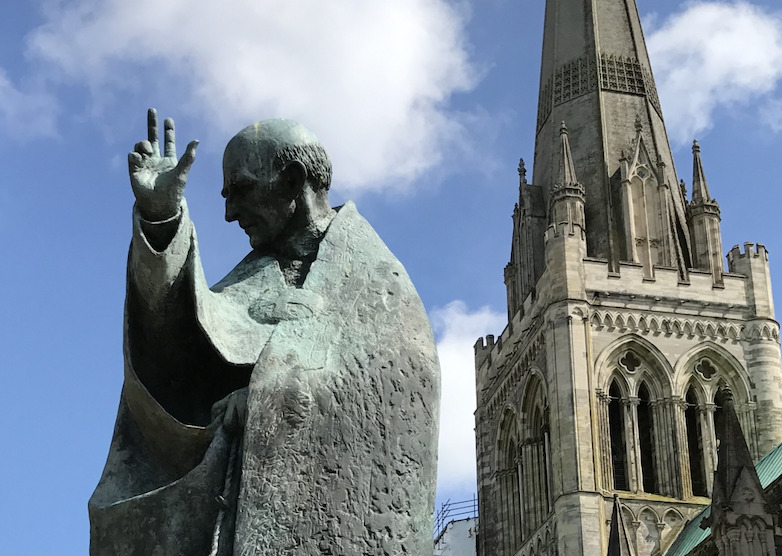
Standing outside the west front of Chichester Cathedral is a striking bronze sculpture of St Richard created by the internationally acclaimed sculptor Philip Jackson, whose studio is based near Chichester.
Commissioned by the Friends of Chichester Cathedral as part of the Millennium celebrations and unveiled on 15 June 2000, the sculpture welcomes visitors as they arrive at the Cathedral. Rather than depicting a remote medieval figure, Jackson portrays Richard as a compassionate and approachable bishop—holding his crozier, quietly confident and ready to greet those who come through the Cathedral gates.
Jackson's work creates a beautiful bridge between Chichester's medieval past and its thriving artistic present. It reminds us that every generation finds new ways to celebrate the people who have shaped the countys identity.
Philip Jackson is one of Britain's most distinguished sculptors, renowned for public commissions throughout the UK and overseas. His local connection with the area makes this sculpture all the more special, linking one of Sussex's greatest historical figures with one of its finest contemporary artists.
I'll be writing more about Philip Jackson in a future article. Having had the privilege of hearing him speak and visiting his home, I know there is another fascinating Chichester story waiting to be told.
Words That Have Endured
Richard is perhaps best remembered for a prayer that has survived for centuries:
May I know Thee more clearly, love Thee more dearly, and follow Thee more nearly, day by day.
Many people will recognise these words from the musical Godspell, which introduced Richards prayer to a whole new generation. Every hour on the hour ,the duty canon delivers a short prayer to visitors to the cathedral and includes these words from St Richard.
Why St Richard Still Matters
Whether viewed through faith, history or simply as the story of an extraordinary individual, Richard's life continues to resonate.
He stood up to political pressure.
He placed principle before personal advancement.
He travelled throughout Sussex meeting ordinary people where they lived.
He believed leadership meant serving others.
These are qualities that transcend the centuries.
As Sussex reflects on its heritage each June, St Richard reminds us that the county's identity has been shaped not only by its landscapes and buildings, but also by people whose values left a lasting mark on the communities they served.
The next time you visit Chichester Cathedral, take a few moments to see both St Richard's shrine inside and Philip Jackson's remarkable bronze sculpture outside.
Together they tell a story that stretches across almost eight centuries—from a humble medieval bishop to a modern work of art that continues to welcome visitors to the heart of Chichester.
Discover More
This is the first in a new collection of articles exploring the rich history, architecture and hidden stories of Chichester Cathedral.
Over the coming months well be uncovering the people, places and craftsmanship that have shaped one of Sussexs most remarkable buildings—from medieval builders and beautiful stone to saints, pilgrims, artists and centuries of fascinating history.
If you enjoy discovering something new about our area, keep an eye on Chichester Living for the next instalment.